

Arc of Label
A tapered tub needs a curved label. Here is how to work out the curve from the container you already have.
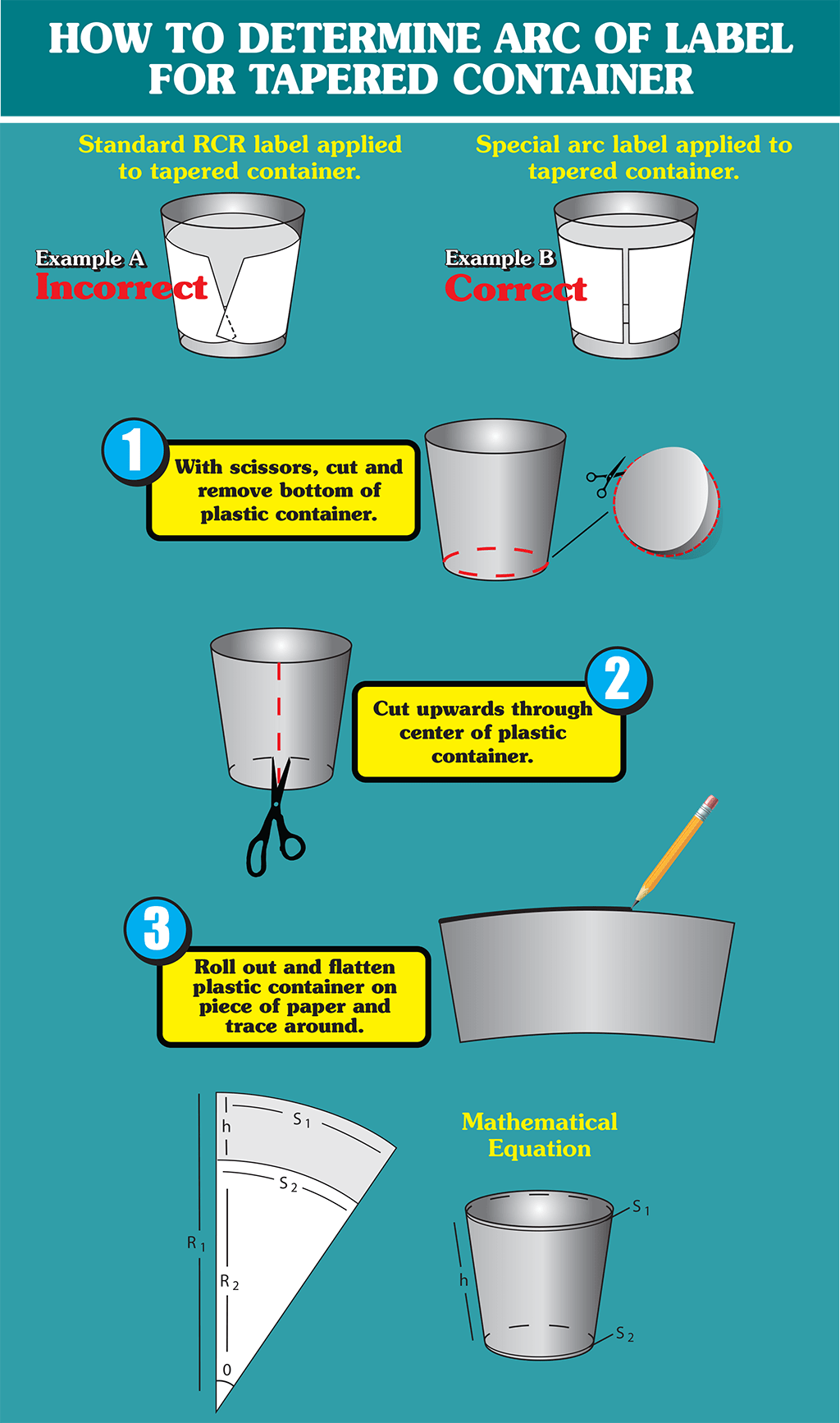
Wrap a plain rectangular label around a tapered container — a deli tub, a yoghurt pot, a paint-style pail — and it will not lie flat. The container’s circumference is bigger at the top than at the bottom, so the straight top and bottom edges of the label fight the taper: the label fishtails, the corners lift and a wrinkle runs up the middle. That is Example A on the diagram below. The fix is a label whose own edges are curved to match, cut on an arc; that is Example B, and it sits down flat all the way round.
The diagram then shows the trick for finding that arc without any maths, using a container you already have on the shelf. Cut the bottom out of a sample container with scissors, cut straight up through one side, then roll it out flat on a sheet of paper and trace around it. What you have traced is the exact developed shape of the container wall — a curved band, wider at the top than at the bottom. Draw your label inside it, send us the tracing, and we have the die.
If you would rather give us numbers than a tracing, the bottom of the diagram is the same thing as geometry: S1 is the circumference at the top of the label, S2 the circumference at the bottom, and h the slant height — measured along the sloping wall, not vertically. Those three give the two radii (R1, R2) and the angle of the arc, which is what the die is cut from. Measure the circumferences with a strip of paper wrapped round the container at each height rather than with a ruler across the diameter; see how to measure a label for that.
Send us the traced shape, or the container itself, and we will build the die line and proof it before anything is cut. Ask for a quote and mention that the container is tapered.